Mobile Solar Systems
To the uninitiated, a solar power bank looks like a standard battery with a small glass window. In reality, these are complex energy management systems. They consist of a lithium-polymer (Li-Po) or lithium-iron-phosphate (LiFePO4) battery integrated with a solar controller and a panel made of monocrystalline or polycrystalline silicon. Monocrystalline panels are the gold standard for travelers because they offer the highest efficiency rates, often between 20% and 23%, meaning they convert more sunlight into electricity per square inch than their cheaper counterparts.
I recently tested a 20,000mAh unit in the High Sierras. While the marketing claimed "infinite power," the reality was more nuanced. On a clear day at 10,000 feet, the solar panel generated roughly 300mA per hour. This sounds small, but over a full day of exposure on a backpack, it provided enough "trickle charge" to offset the energy used by a GPS watch and a smartphone in airplane mode.
The industry benchmark for a high-quality portable solar charger is a conversion efficiency of at least 21%. Units like the Anker Solix or the Goal Zero Nomad series have set the bar by using ETFE (Ethylene Tetrafluoroethylene) coatings. This material is more UV-transparent and durable than the standard PET plastic found on budget devices, ensuring the panel doesn't "cloud" and lose efficiency after a month in the sun.
Solar Adoption Pitfalls
The most significant mistake beginners make is relying on the built-in solar panel of a small power bank as their primary charging source. A standard 20,000mAh power bank has a surface area of roughly 15 square inches. At standard solar irradiance ($1000 W/m^2$), such a small panel would take upwards of 80 to 100 hours of direct, perfect sunlight to charge the internal battery from 0% to 100%.
In real-world scenarios, travelers often find themselves with a dead battery and no way to quickly revive it because they misunderstood the "emergency only" nature of integrated panels. This leads to "bricking" essential devices like satellite messengers (e.g., Garmin inReach) during critical moments.
Furthermore, heat is the silent killer of solar efficiency. Batteries and solar panels both suffer when they exceed 45°C (113°F). Many users leave their power banks on hot dashboards or in direct, stagnant desert heat, which causes the lithium cells to degrade or, in extreme cases, swell and fail. Without proper airflow, a solar charger actually becomes less efficient the hotter it gets, creating a paradox where the strongest sun provides the weakest charge.
Optimizing Off-Grid Energy
Selecting High-Efficiency Monocrystalline Cells
Not all silicon is created equal. When shopping for a solar-capable power bank, prioritize monocrystalline cells. Brands like SunPower provide the raw cells for many high-end portable chargers. These cells are cut from a single crystal of silicon, allowing electrons more room to move, which results in higher efficiency. If a product listing doesn't specify "monocrystalline," it is likely using polycrystalline, which loses significant performance in overcast conditions or when partially shaded.
Decoding mAh vs. Wh for True Capacity
Marketing teams love "mAh" (milliamp-hours) because the numbers look bigger. However, "Wh" (Watt-hours) is the true measure of energy. A 20,000mAh battery at 3.7V is 74Wh. If you are flying to your destination, remember that the FAA and EASA generally limit carry-on batteries to 100Wh. Devices like the Omnicharge Omni 20+ or Sherpa 100AC sit right at this limit, providing maximum legal energy for a traveler. Calculating your daily burn—phone (12Wh), headlamp (3Wh), camera (10Wh)—allows you to size your battery so you never drop below a 20% safety buffer.
The Role of MPPT Charge Controllers
For serious off-grid use, look for "Maximum Power Point Tracking" (MPPT) technology. While more common in larger "solar generators" like those from Jackery or EcoFlow, some high-end portable kits use simplified MPPT. This technology actively monitors the voltage and output of the solar panels to ensure the battery is receiving the most efficient "charge" possible, even as cloud cover fluctuates. Standard "PWM" controllers are cheaper but waste about 20% of the energy harvested by the panels.
Prioritizing Pass-Through Charging Capabilities
A vital feature for the nomadic traveler is pass-through charging. This allows the solar panel to charge the power bank while the power bank simultaneously charges your phone. Without this, you have to wait for the battery to fill up before you can use the energy. Units from BioLite often feature this, integrated into a ecosystem of "Charge" series batteries that handle fluctuating solar input without disconnecting the output device—a common flaw in cheaper electronics.
Environmental Sealing and IP Ratings
Off-grid travel involves dust, rain, and drops. An "IP67" rating is the gold standard here. The "6" means it is dust-tight, and the "7" means it can survive immersion in water up to 1 meter for 30 minutes. If you are kayaking or trekking in the Pacific Northwest, a solar bank without a ruggedized, sealed port covers is a liability. The Dark Energy Poseidon Pro is a prime example of a battery built for these extremes, tested to military standards for drop and water resistance.
Impact of Temperature on Charging Speeds
Solar panels work best when cold, but batteries need to be warm to charge. This is the "Traveler’s Dilemma." If you are in the Himalayas, your solar panel will be highly efficient in the thin, cold air, but your battery might refuse to take a charge if its internal temperature is below freezing. Expert travelers keep the battery unit inside their jacket or insulated in a pack, using a long cable to connect it to the solar panels mounted externally.
Comparative Case Studies
Case Study 1: The Appalachian Trail Thru-Hiker
A hiker used a 28W foldable solar panel paired with a 10,000mAh power bank. By hanging the panels on the back of their pack (a method known as "solar backpacking"), they harvested enough energy to keep a smartphone and a Garmin Fenix watch charged for 14 days without ever touching a wall outlet.
- The Setup: BigBlue 28W Charger + Anker PowerCore 10k.
- The Result: Consistent 1.5A to 2A output during mid-day sun, resulting in a full 10,000mAh charge every 2-3 days of hiking.
Case Study 2: The Baja Overland Expedition
A photography team in Baja, Mexico, needed to charge drone batteries (DJI Mavic series) while stationary. They avoided small "integrated" solar banks and opted for a 100W briefcase panel and a 500Wh portable power station.
- The Setup: Jackery Explorer 500 + SolarSaga 100W.
- The Result: They were able to fly 4-5 sorties per day. The 100W panel returned the power station to 100% within 6 hours of peak desert sun, providing total energy independence for a 7-day shoot.
Solar Hardware Checklist
| Feature | Beginner Spec | Expert/Pro Spec |
|---|---|---|
| Panel Type | Polycrystalline (15% eff.) | Monocrystalline (22%+ eff.) |
| Battery Chemistry | Li-ion | LiFePO4 (Lasts 3000+ cycles) |
| Port Output | USB-A (5V/2A) | USB-C PD (60W or higher) |
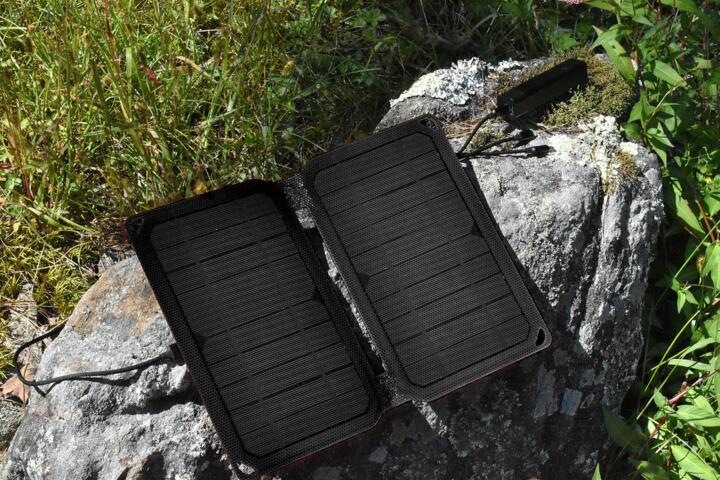
| Solar Input | Integrated (1W-2W) | External Foldable (21W-100W) |
| Durability | No IP Rating | IP67 Water/Dust Proof |
| Weight | Heavy Lead-Acid | Lightweight High-Density Polymer |
Avoiding Gear Failures
One of the most frequent errors is using a long, cheap USB cable between the solar panel and the power bank. Thin cables have high internal resistance, causing a significant "voltage drop." You might harvest 10W at the panel but only deliver 5W to the battery. Always use short, high-gauge (thick) cables rated for fast charging.
Another failure point is "Partial Shading." On many cheap solar arrays, if even 10% of the panel is covered by a leaf or a backpack strap, the output of the entire panel can drop by 50% or more. High-end panels use "bypass diodes" to prevent this, ensuring that if one cell is in the shade, the others continue to produce power at full capacity.
Lastly, never store your solar power bank at 0% or 100% for long periods. Lithium batteries are most stable at 40-60% charge. If you store it completely empty after a trip, the "parasitic drain" of the internal circuitry can pull the voltage so low that the battery's protection circuit permanently disables the unit for safety.
FAQ
Can I charge a solar power bank through a window?
Yes, but it is highly inefficient. Standard window glass reflects or absorbs a significant portion of the UV and IR spectrum that solar cells need. Expect a 30% to 50% drop in charging speed compared to being outside.
How do I know if my solar panel is actually working?
Invest in a cheap USB Multimeter (like those from Klein Tools). This small device plugs between your panel and battery to show you the exact Voltage (V) and Amperage (A) being produced. It removes the guesswork.
Is it safe to leave a solar power bank in the sun all day?
Only if it is designed for it. High-quality units have thermal cut-offs. However, it is always better to keep the battery in the shade (under the panel or in a bag) while the panel itself is in the sun.
What size panel do I need for a 20,000mAh battery?
For a "full charge in one day" scenario, you need at least a 21W foldable panel. Integrated 1W panels on the back of batteries are for emergency maintenance, not primary charging.
Does altitude affect solar charging?
Yes, positively! For every 1,000 meters of elevation gain, solar intensity increases by approximately 10% to 12% because there is less atmosphere to scatter the light. High-altitude trekkers actually have an advantage.
Author’s Insight
In my fifteen years of backcountry travel, I’ve learned that "redundancy is reality." I never rely on a single large power bank; I prefer two medium-sized units. If one falls into a river or suffers a thermal failure, I’m not stranded. I also stopped buying "all-in-one" solar batteries. The heat required to charge the solar panel is fundamentally bad for the battery's lifespan. My preferred setup is a standalone, high-efficiency foldable panel like the PowerFilm Rollable series paired with a separate, ruggedized power bank. This allows me to keep the electronics cool while the panels bake in the sun.
Summary
Successfully using solar power for off-grid travel requires moving past the "set it and forget it" mentality. By selecting monocrystalline panels, understanding the difference between Wh and mAh, and utilizing proper cable management, you can maintain a perpetual energy loop. Prioritize gear with IP67 ratings and USB-C Power Delivery to ensure compatibility with modern devices. The goal isn't just to have a battery; it's to have a reliable power ecosystem that allows you to explore further and stay longer without compromise. Ensure your hardware is matched to your daily energy "burn rate," and always carry a dedicated, external solar folding kit for any trip lasting longer than three days.